
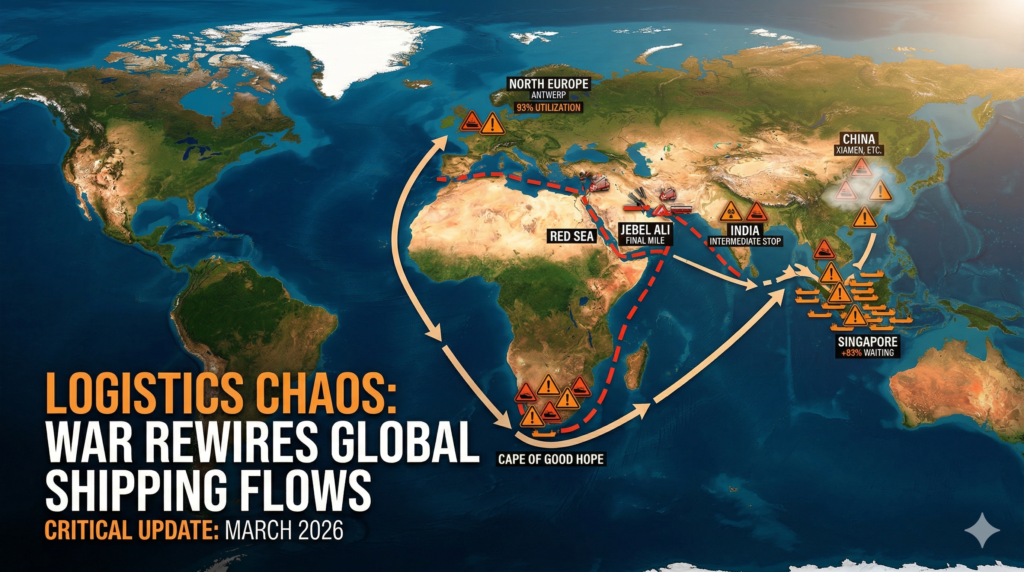
If the past few years taught the supply chain industry how to navigate congestion, what we are seeing today is an entirely different landscape. This is not just standard operational congestion; this is congestion driven by geopolitical conflict, mass rerouting, and structural imbalance. The shockwaves are now spreading simultaneously across Asia, Africa, and key global hubs.
Here is a breakdown of what is truly happening on the ground and how it impacts your cargo.
The Bigger Picture: War is Rewiring Vessel Flows
The escalation of the Iran–Israel conflict has triggered a massive shift in global shipping operations. The disruption of the Strait of Hormuz (one of the world’s most critical shipping chokepoints), compounded by Houthi threats in the Strait of Bab El Mandeb at the Red Sea, has forced carriers to make drastic changes.
Shipping lines are actively avoiding the Red Sea and Gulf routes, triggering mass rerouting and vessel bunching globally. Carriers are not just delayed—they are reconfiguring entire networks.
Where Congestion is Actually Happening (March 2026 Data)
1. Southeast Asia: The Pressure on Indonesia’s Lifeline
The most critical impact for Indonesian trade is happening in our neighboring transshipment hubs:
- Singapore (SGSIN): Vessel waiting times have surged, with up to 41 ships at anchorage—an 83% increase versus previous weeks.
- Port Klang & Tanjung Pelepas (Malaysia): Backlogs are increasing rapidly as diverted, Gulf-bound cargo is “parked” at these hubs.
- Regional Reality: Expect longer queues, slower berth access, and rising delays across all Asian ports.
2. Africa: The Hidden Congestion Cluster
While Asia grabs the headlines, Africa is quietly facing severe congestion as vessels reroute via the Cape of Good Hope. Africa has become a new bottleneck zone and an overstretched capacity absorber:
- Conakry (Guinea): ~19–22 days waiting time.
- Dar es Salaam (Tanzania): ~13.6 days delay.
- Mombasa (Kenya): ~7+ days, heavily impacted by equipment shortages.
- Tema (Ghana): Severe congestion exacerbated by crane outages.
3. Europe: High Yard Utilization
Major European ports, including Antwerp, Rotterdam, and Hamburg, are seeing yard utilization reach critical levels of 93%. This results in truck turnaround delays, longer container dwell times, and much slower equipment repositioning back to Asia.
4. China & North Asia: Weather Meets Operational Disruption
Major ports (Shanghai, Qingdao, Ningbo, Tianjin, Xiamen) have been hit by dense fog disruptions. Combined with the ongoing crisis, this is causing high vessel schedule unreliability and missed connections to Southeast Asia.
5. Fuel Congestion: The Overlooked Bottleneck
Key refueling hubs like Singapore, Shanghai, and Zhoushan are facing severe bunker congestion and localized fuel shortages, leaving ships struggling to refuel and causing further delays.
6. India: The Decision Point Risk
Many vessels traveling to and from the Middle East are choosing Indian ports as alternative hubs. This means delays are now multi-layered. Cargo is not just facing risks at primary hubs (Singapore/Port Klang) but also at secondary hubs in India before even reaching its destination port.
The Chain Reaction
This is not isolated congestion. We are witnessing a clear chain reaction:
- Geopolitical conflict disrupts Middle East routes.
- Ships reroute, resulting in much longer voyages.
- Vessels arrive late, causing bunching at subsequent ports.
- Transshipment hubs overload.
- Containers get stuck, leading to severe equipment shortages.
- New congestion clusters form worldwide.
Executive Summary: Cargo Risk Guidance
Certain trade lanes face extreme challenges, particularly Chattogram, Colombo, and Karachi. These three ports have seen a decreased volume of vessels due to changing carrier strategies at hub ports. If your cargo rolls over on these routes, the next available vessel could be weeks away.
Based on current risk levels, here is our strategic guidance for your production planning:
| Area / Route | Risk Level | Primary Cause |
| Export LCL/FCL via Singapore/Port Klang | Very High | Transshipment congestion |
| Export LCL/FCL to Karachi, Colombo, Chattogram | Very High | Limited vessels at transshipment ports |
| Import from Europe | Very High | Rerouting + EU congestion |
| Import from China | Medium-High | Schedule & weather disruption |
| Air Freight | Rising | Airspace restrictions + capacity pressure |
Spotlight: Navigating the Jebel Ali “Final Mile”
Jebel Ali is experiencing a new reality. Previously, cargo moved from Asia on direct vessels to Jebel Ali. Today, Jebel Ali has become a “Final Mile” port, requiring alternative routing and feeder or truck connections.
Here are the real, operational workarounds currently utilized by carriers:
- The Oman Corridor (Primary Workaround): Ports like Sohar and Salalah are fully operational outside the Strait of Hormuz. Connected via bonded trucking to the UAE, Saudi Arabia, and Qatar, this is currently the most stable “new gateway” to the Gulf.
- UAE East Coast Bypass: Cargo is discharged at Khorfakkan or Fujairah (outside the Hormuz risk zone) and moved inland via truck to Dubai/Jebel Ali.
- Red Sea Corridor: Cargo from Asia or Europe is discharged at Jeddah or King Abdullah Port and moved via land bridge (truck/rail) across Saudi Arabia to GCC countries.
- The Africa Route: When both the Suez and Red Sea are completely unsafe, ships take the long-haul Cape of Good Hope route, adding 10 to 14 days of transit and higher fuel costs.
- The India “Drop-Off”: Shipping lines terminating voyages early are discharging Gulf-bound containers in Nhava Sheva or Mundra, forcing shippers to arrange their own onward movement.
We Are Here to Help
Navigating this rewired global network requires proactive scenario planning. Should you need any support, strategic advice, or shipment-specific updates, please feel free to reach out to our team at any time.
Warm Regards, PT Gateway Container Line Contact: info@gateway-id.com | (62-21) 8591 8669
Sources:
- Wall Street Journal: Hapag-Lloyd warns of earnings slump
- Portcast.io: Strait of Hormuz live information
- Reuters: Asia bunker premiums hit record highs
- Business Times: Singapore, Tg Pelepas, Port Klang face capacity shortage
- Xeneta: How port congestion and schedule chaos are hitting shippers