
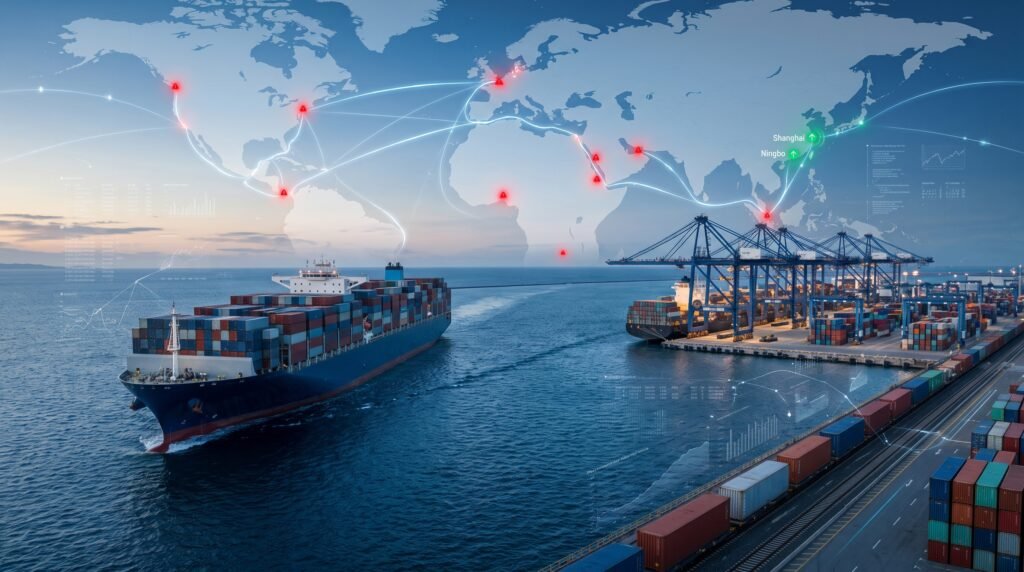
The global logistics landscape is entering a new phase. After months of severe congestion at China’s major ports, conditions are finally improving. However, supply chain risks have not disappeared. Instead, they have shifted to new areas, including labor strikes, rail bottlenecks, weather disruptions, and geopolitical tensions.
For importers and exporters, especially those moving cargo through Asia and Indonesia, understanding where the next disruption may occur is becoming more important than ever.
China Congestion Finally Shows Signs of Relief
The biggest story this month is the gradual recovery of China’s major gateways.
Ports such as Shanghai and Ningbo, which experienced significant vessel queues during September and early October, have seen waiting times decline considerably. Global schedule reliability has also improved slightly, signaling that carriers are beginning to stabilize operations after months of disruption.
The recovery, however, remains fragile.
Typhoon Champi temporarily interrupted progress by forcing operational suspensions across parts of Eastern China and Taiwan. Although terminals have resumed operations, backlogged cargo, vessel bunching, and schedule disruptions are expected to continue into November.
For shippers moving Less-than-Container Load (LCL) cargo, this means that delays can still occur even when ports themselves appear to be operating normally. Missing a consolidation window or transshipment connection may continue to impact transit times.
Global Schedule Reliability Stops Declining
According to recent industry data, global schedule reliability improved to 50.6% during September, up from 49.9% in August.
While this marks a positive development, reliability remains far below the peak level reached earlier in the year. On average, delayed vessels are still arriving more than six days behind schedule.
In practical terms, cargo owners should continue building contingency time into supply chain planning because vessel delays remain common across many trade lanes.
Southeast Asia: Transshipment Hubs Remain Under Pressure
Singapore, Port Klang, and Tanjung Pelepas continue to play critical roles as regional transshipment centers for cargo moving to and from Indonesia.
Although congestion at Singapore has improved significantly compared to early October, connection reliability remains a concern. Missed feeder services, revised schedules, and vessel rollovers continue to affect shipment visibility and transit consistency.
Manila has emerged as one of the more concerning locations in Asia. Vessel waiting times have been steadily increasing throughout October, indicating growing pressure on terminal operations and local logistics networks.
For businesses relying on regional transshipment hubs, schedule disruptions can still occur even when cargo is not moving through highly congested ports.
Europe Faces Labor Strikes, Weather Disruptions, and Cybersecurity Challenges
While European ports are generally avoiding severe vessel congestion, operational risks are rising for other reasons.
Coordinated labor actions involving more than 50 ports were planned for 30 October, affecting key gateways across France, Greece, Spain, Italy, Turkey, and Morocco. Even a one-day work stoppage can create backlogs that require several days to clear.
French ports face particularly significant challenges. Le Havre and Marseille-Fos have been impacted by a combination of labor strikes, severe weather events, and cybersecurity incidents that disrupted terminal operations.
Businesses with cargo routed through Europe should closely monitor potential delays extending beyond the strike period itself.
North America: The Bottleneck Has Moved Inland
Unlike previous years, the primary challenge at the Ports of Los Angeles and Long Beach is no longer vessel congestion.
Instead, rail infrastructure has become the main concern.
More than 35,000 containers are currently waiting for on-dock rail services, creating extended dwell times and slowing cargo movement inland. Additional uncertainty comes from the possibility of labor action involving key port workers.
This development highlights an important trend in global logistics: a port may appear operational while cargo still faces significant delays due to downstream transportation constraints.
Red Sea and Middle East: Geopolitical Risks Remain High
One of the most significant uncertainties for global shipping continues to be the Red Sea region.
More shipping lines are returning to Suez Canal routing as carriers seek shorter transit times and improved vessel utilization. However, security conditions remain unstable, and maritime incidents continue to be reported.
Any escalation could quickly lead to route changes, additional surcharges, longer transit times, and sudden schedule adjustments.
For shippers moving cargo between Asia and Europe, geopolitical developments remain one of the most important risks to watch through 2027.
Africa Continues to Experience Severe Port Delays
Several African gateways remain among the world’s most congested ports.
Durban continues to struggle with vessel backlogs, equipment shortages, and terminal congestion. Tema and Abidjan have also seen waiting times increase throughout October due to high yard utilization and landside capacity constraints.
These conditions continue to create uncertainty for businesses trading with African markets and may require additional transit-time buffers.
Air Freight Becomes an Increasingly Attractive Alternative
As ocean freight schedules remain unpredictable, many shippers are reconsidering air cargo options.
Global air freight demand strengthened during October, particularly following the post-Golden Week recovery in Asia. Capacity remains tight and rates are expected to stay elevated, but air transport continues to provide an effective solution for time-sensitive shipments.
Businesses should especially consider air freight when:
- Production schedules cannot tolerate delays
- Inventory replenishment is urgent
- Cargo has already missed multiple vessel departures
- High-value goods require faster transit
- LCL cargo risks missing consolidation cycles
What This Means for Indonesian Importers and Exporters
For Indonesian businesses, the outlook is improving but remains far from risk-free.
The reduction in congestion across China is welcome news, particularly for cargo originating from Shanghai and Ningbo. However, disruption risks are increasingly being driven by factors outside the port itself, including labor strikes, transshipment delays, rail bottlenecks, weather events, and geopolitical developments.
Successful shipment planning in the coming weeks will require greater flexibility, realistic transit-time expectations, and close monitoring of supply chain developments across multiple regions.
Key Takeaway
Global shipping is no longer facing a single dominant disruption point. Instead, risks are becoming more dispersed across the supply chain.
China’s congestion is easing, but labor strikes in Europe, rail backlogs in North America, geopolitical uncertainty in the Red Sea, and persistent congestion in parts of Africa are creating new operational challenges.
For importers and exporters, the most effective strategy remains proactive planning, early booking, and maintaining sufficient lead time to absorb unexpected disruptions.
At Gateway Container Line (GCL), we continue to monitor global shipping developments, carrier schedules, port conditions, and transshipment hubs to help customers make informed logistics decisions and keep cargo moving efficiently.